navy blue pixelated rendering of a pen on writing on paper symbolizing the blog on the website

Choosing the Right Carpet for High-Traffic Areas in Your Home or Business

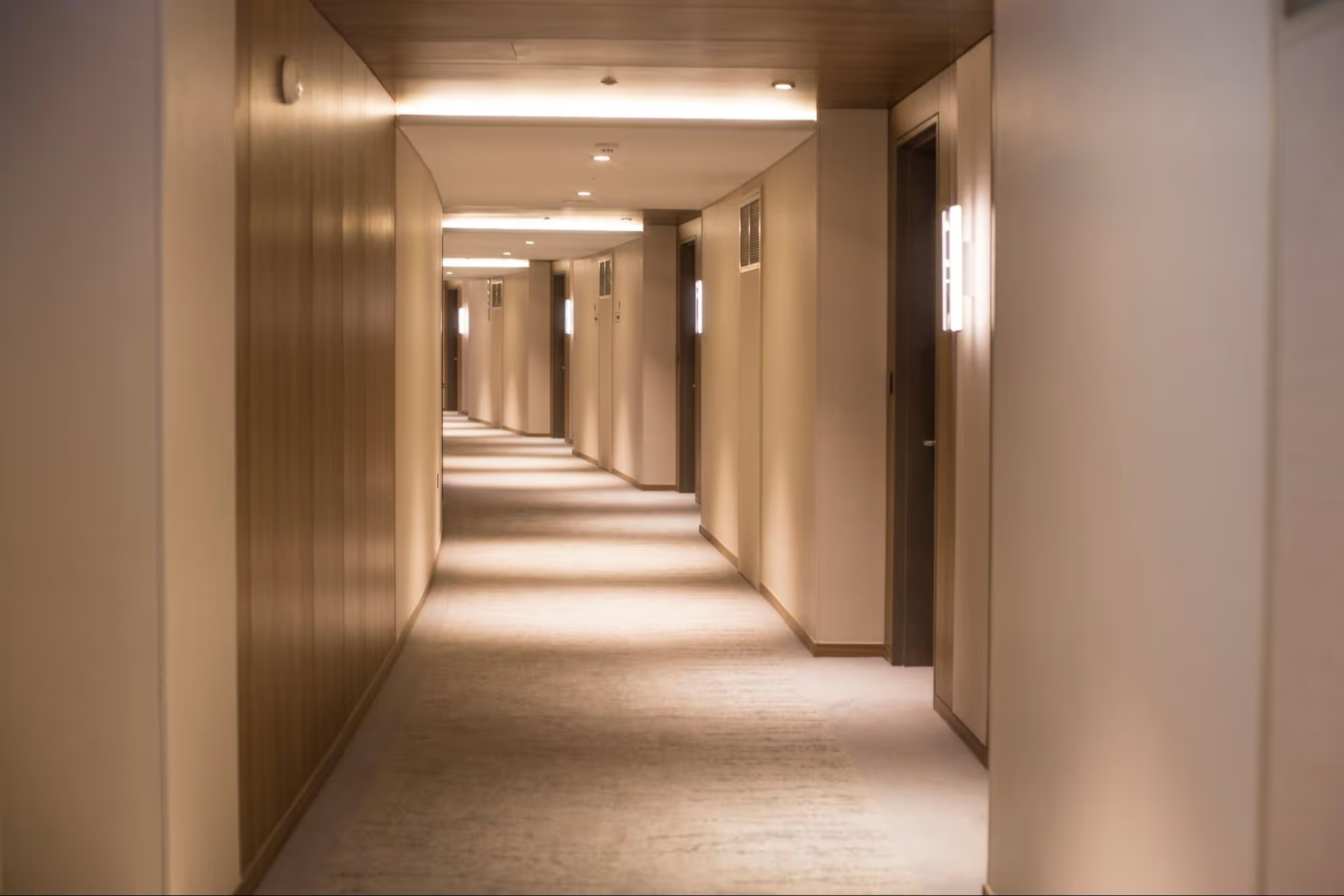
Warmly lit interior corridor featuring carpeted flooring, wood wall paneling, modern sconces, and refined commercial flooring by C.S. Brown Flooring.

Post Summary

What makes a carpet durable enough for high-traffic areas and how do you evaluate it before purchasing?

Three variables determine high-traffic carpet durability: fiber type, density, and pile height. Nylon is the benchmark fiber for demanding applications — it resists abrasion, recovers from compression, and maintains its appearance longer than polyester or olefin under sustained foot traffic. Density, measured by how closely fibers are packed per square inch, directly determines wear resistance — a simple test is bending the carpet back to check whether the backing is visible through the fibers, which signals insufficient density. Shorter pile heights resist crushing and matting better than plush or deep-pile constructions, making them the practical specification for hallways, lobbies, and any space that sees daily high-volume use.

Which carpet styles perform best in high-traffic residential and commercial settings?

Loop pile carpets — where yarn loops remain uncut — are the strongest performers in high-traffic applications. Berber is the most recognized loop pile style, producing a tough surface that hides footprints and vacuum marks while working in both residential and commercial settings. For cut-pile options, textured and frieze styles with shorter, denser construction handle heavy use well — their twisted fibers camouflage wear patterns and footprints in ways that smooth, uniform cut piles do not. Patterned carpets, whether the pattern comes from color variation or textural difference, are a strong commercial choice because they maintain a professional appearance longer between cleanings by naturally disguising soil and imperfections.

How does carpet color affect performance and appearance in busy areas?

Color choice is a practical durability decision as much as an aesthetic one. Very light and very dark solid colors both show dirt, wear, and staining more readily than mid-tones. Multi-toned and heathered carpets — those incorporating several complementary colors in a single design — perform significantly better in high-traffic areas because the variation naturally disguises soil and surface imperfections between cleanings. Warm neutrals including taupe, warm gray, and multi-toned brown consistently perform well across residential and commercial applications. For commercial environments, the goal is finding a color that complements the brand or décor while providing the camouflage benefit that mid-toned, multi-toned carpets deliver.

What role does carpet padding play in high-traffic performance and how should it be specified?

Carpet padding absorbs impact, reduces wear on the carpet backing, and extends overall floor life — making it as important as the carpet itself in high-traffic applications. For busy residential areas, padding density of at least 6.5 pounds is the minimum specification; commercial spaces should use 8 pounds or higher. Rubber padding outperforms foam in durability and longevity. Thickness should fall between three-eighths and seven-sixteenths of an inch for high-traffic zones — thicker padding causes excessive carpet flex that accelerates wear along traffic paths. Specifying quality padding upfront consistently extends carpet lifespan by years, making it one of the highest-return investments in any flooring project.

What maintenance practices keep high-traffic carpet looking its best over time?
Daily vacuuming in high-traffic zones is the most important maintenance practice — fine dirt particles that work deep into carpet fibers act as an abrasive that breaks down the fiber structure from within, and vacuuming prevents this accumulation before it causes damage. Walk-off mats at all entrances capture soil before it reaches the carpet and dramatically reduce the total cleaning burden. Professional hot water extraction cleaning should occur at least annually in residential high-traffic areas and quarterly or more frequently in commercial settings. Stain-resistant and soil-resistance treatments applied during manufacturing help liquids bead on the surface and prevent dirt from bonding to fibers, making routine vacuuming more effective and professional cleaning easier.

When selecting carpet for spaces with constant foot traffic, making the right choice can mean the difference between a floor that looks great for years and one that shows wear within months. Whether you're outfitting a bustling office lobby, a busy family hallway, or a commercial retail space, understanding what makes a carpet durable and long-lasting is essential to protecting your investment.

High-traffic areas demand more from your flooring than any other area of your property. These spaces endure daily wear from countless footsteps, potential spills, dirt tracked in from outside, and the general challenges of constant use. The good news? With the right information and quality materials, you can find carpet that not only withstands heavy use but continues to look beautiful year after year.

1. Understanding What Makes a Carpet Durable

Not all carpets are created equal, especially when it comes to durability. The construction and materials of your carpet play crucial roles in how well it performs under pressure. Dense, tightly woven carpets with shorter pile heights tend to resist crushing and matting better than their plush, luxurious counterparts. While those soft, deep-pile carpets feel wonderful underfoot, they're not designed for areas where people walk constantly.

The fiber type is equally important. Nylon remains the gold standard for high-traffic applications because of its exceptional resilience and ability to bounce back after compression. It resists staining, holds up against abrasion, and maintains its appearance longer than most other fibers. Polyester and olefin are more budget-friendly options, but they don't quite match nylon's durability in demanding environments.

Carpet density, measured by how closely the fibers are packed together, directly impacts longevity. A denser carpet means more fibers per square inch, which translates to better wear resistance. When you're shopping, don't be afraid to bend the carpet back and look at the backing. If you can easily see through to the backing, the carpet likely isn't dense enough for heavy traffic.

2. The Best Carpet Styles for Heavy Use

When durability is your priority, certain carpet styles consistently outperform others. Loop pile carpets, where the yarn loops remain uncut, create an exceptionally tough surface that hides footprints and vacuum marks beautifully. Berber is the most recognized loop pile style, offering a casual, textured look that works in both residential and commercial settings.

Cut-pile carpets can also work well in high-traffic areas, but you'll want to stick with shorter, denser options, such as textured or frieze styles. These carpets have a more casual appearance due to their twisted fibers, which help hide footprints, stains, and wear patterns. The texture adds visual interest while providing the practical benefits you need.

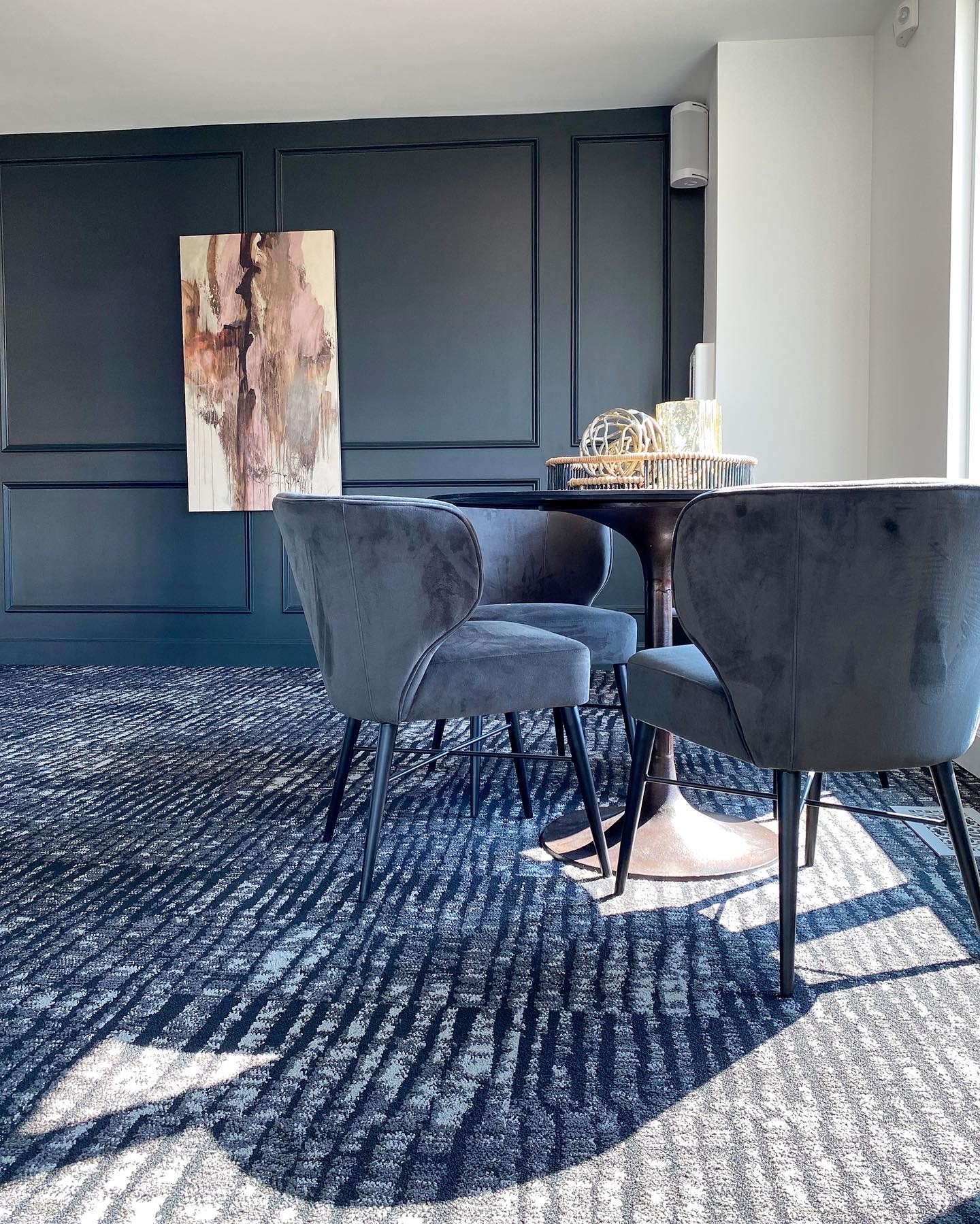
Pattern carpets deserve special consideration for busy areas. Whether the pattern is created through color variations or textural differences, these carpets excel at camouflaging dirt and wear. For commercial spaces, especially, patterned carpet can maintain a professional appearance longer between cleanings, making it a smart choice for offices, hotels, and retail environments.

3. Color Matters More Than You Think

The color you choose significantly impacts how well your carpet maintains its appearance in high-traffic areas. While it might be tempting to choose very light or very dark colors, both show dirt, stains, and wear more obviously than medium tones.

Multi-toned or heathered carpets work magic in busy spaces. These carpets incorporate several complementary colors in their design, creating depth and variation that naturally disguises soil and imperfections. A heathered gray, for instance, can hide far more than a solid gray of the same shade.

For commercial applications, consider how your color choice aligns with your brand while still being practical. Many businesses successfully balance aesthetics and function by choosing colors that complement their décor while providing camouflage benefits for heavy traffic. Warm neutrals like taupe, warm grays, and multi-toned browns consistently perform well across various settings.

4. Special Treatments and Technologies

Modern carpet manufacturing has introduced treatments that significantly enhance performance in challenging environments. Stain-resistant treatments are nearly essential for high-traffic areas, as they help liquids bead up on the surface rather than immediately soaking in. This gives you precious time to clean up spills before they become permanent stains.

Some manufacturers offer advanced soil-resistance treatments that create a barrier around individual carpet fibers. This technology prevents dirt from bonding to the fiber, making routine vacuuming more effective and deep cleaning easier. For businesses or homes with children and pets, these treatments can be game-changers.

Antimicrobial treatments have also gained popularity, particularly in commercial and healthcare settings. These treatments inhibit the growth of bacteria, mold, and mildew within carpet fibers, improving indoor air quality and a healthier environment overall.

5. Carpet Padding: The Unsung Hero

Many people focus solely on the carpet itself, overlooking the crucial role of the quality padding underneath. The right carpet pad absorbs impact, reduces wear on the carpet backing, and extends the life of your flooring investment. For high-traffic areas, you'll want a firmer, denser pad rather than a soft, cushiony one.

Look for padding with a density of at least 6.5 pounds for residential applications and 8 pounds or higher for commercial spaces. Rubber padding offers excellent durability and doesn't deteriorate as quickly as foam options. While it costs more upfront, quality padding pays dividends by extending your carpet's lifespan by years.

Thickness matters too, but thicker isn't always better for high-traffic zones. A pad between 3/8 and 7/16 inch thick provides adequate cushioning while maintaining the stability needed in busy areas. Too thick, and the carpet may flex excessively, accelerating wear along traffic paths.

6. Maintenance Requirements and Long-Term Care

Even the most durable carpet requires proper maintenance to look its best. Before making your selection, consider the maintenance commitment each option requires. Some carpets need more frequent professional cleaning, while others remain presentable with routine vacuuming alone.

Establish a regular maintenance routine from day one. Daily vacuuming in high-traffic areas prevents dirt particles from working their way deep into the fibers where they act like sandpaper, breaking down the carpet structure. Use walk-off mats at entrances to capture dirt before it reaches your carpet, dramatically reducing the soil load.

Professional cleaning should occur at least annually for residential high-traffic areas and more frequently for commercial spaces. Hot water extraction cleaning, commonly called steam cleaning, remains the most effective method for removing embedded soil and refreshing carpet appearance. Some commercial applications benefit from quarterly professional cleaning to maintain a consistently professional look.

7. Residential vs. Commercial Considerations

While the fundamental principles of selecting durable carpet remain consistent, residential and commercial applications have different priorities. Homes with children and pets face challenges similar to commercial spaces, requiring carpets rated for heavy use even in residential settings.

Commercial carpet often carries specific performance ratings and certifications that indicate its suitability for different traffic levels. Look for carpets rated for heavy commercial traffic if you're outfitting an office, retail space, or hospitality environment. These carpets undergo rigorous testing to ensure they meet industry standards for durability.

Warranties also differ significantly between residential and commercial applications. Pay close attention to warranty terms, particularly regarding wear and staining. A comprehensive warranty from a reputable manufacturer provides peace of mind and protection for your investment.

Making Your Decision with Confidence

Choosing carpet for high-traffic areas doesn't mean sacrificing style for function. Today's carpet options offer an impressive array of colors, patterns, and textures that deliver both durability and aesthetic appeal. Start by honestly assessing your traffic levels, lifestyle or business needs, and maintenance capabilities.

Visit showrooms to see and feel samples in person. Bring photos of your space and discuss your specific requirements with flooring professionals who understand the nuances of different products. Don't hesitate to request samples to take home so you can see how colors and textures look in your actual lighting conditions.

Consider the total cost of ownership, not just the initial price. A slightly more expensive carpet with superior durability and easier maintenance may cost less over its lifetime than a cheaper option that needs replacement sooner. Factor in padding quality, installation expertise, and warranty coverage when making your decision.

The right carpet for your high-traffic areas exists, combining durability to withstand daily wear with style to enhance your space. By focusing on quality materials, appropriate construction, and proper maintenance, you'll enjoy beautiful, long-lasting floors that stand up to whatever life throws their way.

Ready to find the perfect carpet for your high-traffic spaces? The experts at C.S. Brown are here to help you navigate the options and select flooring that meets your specific needs. Schedule your consultation today and discover how the right carpet can transform your home or business while standing up to the toughest demands. Contact us now to get started on creating beautiful, durable spaces that last.

Key Points

What construction and material specifications separate high-performing high-traffic carpet from carpet that fails prematurely?

  • Fiber type is the foundational specification variable because it determines how the carpet responds to abrasion, compression, and staining across years of use. Nylon's molecular resilience — its ability to spring back after compression — is the characteristic that makes it the benchmark for high-traffic applications and that polyester and olefin cannot match under sustained demanding conditions.
  • Fiber density determines wear resistance more directly than any other construction variable. More fibers per square inch means more material absorbing each footstep's impact and friction, distributing wear across a larger surface area rather than concentrating it on fewer fibers. The bend test — checking whether backing is visible when the carpet is folded back — is the field assessment that reveals whether density is adequate before purchase.
  • Pile height affects both durability and appearance maintenance in high-traffic environments. Shorter pile resists crushing and matting because fibers have less distance to deflect and less recovery distance required after compression. Deep, plush pile feels luxurious but deforms under sustained traffic in ways that shorter constructions resist — a tradeoff that makes pile height selection a practical rather than purely aesthetic decision.
  • Stain-resistant treatments are effectively non-negotiable in high-traffic applications because the volume of foot traffic directly correlates with the frequency of spills, tracked moisture, and soil contact. Treatments that cause liquids to bead on the surface provide the response window that prevents most spills from becoming permanent stains — a performance characteristic that becomes more valuable as traffic volume increases.
  • Antimicrobial treatments address the indoor air quality and hygiene implications of high-traffic carpet in commercial, healthcare, and family home environments. These treatments inhibit bacterial, mold, and mildew growth within the fiber structure — a health benefit that becomes particularly significant in spaces where the volume of foot traffic introduces significant biological material from outdoor environments.
  • Twist level in cut-pile constructions affects how well fibers maintain their integrity under repeated compression. Higher twist levels produce fibers that return more consistently to their original position after being compressed underfoot, slowing the progression toward the matted, flattened appearance that signals end-of-life in cut-pile carpet subjected to high traffic.

How do loop pile, cut pile, and patterned carpet styles compare in high-traffic performance and which applications suit each best?

  • Loop pile carpet's uncut yarn structure creates a surface that is inherently resistant to crushing because the loop construction distributes compression stress across both legs of each fiber loop rather than concentrating it at a single fiber tip. This structural advantage makes loop pile carpets — and Berber specifically — the consistent recommendation for the highest-traffic residential and commercial applications.
  • Berber's textured appearance produces a visual camouflage effect that hides footprints, vacuum marks, and minor soiling in ways that smooth, uniform surfaces do not. This camouflage benefit is not cosmetic — it means the carpet maintains an acceptable appearance between cleanings under traffic volumes that would make a smooth-surface carpet appear dirty within hours of vacuuming.
  • Frieze and textured cut-pile styles deliver the best high-traffic performance within the cut-pile category because their twisted fiber structure creates the same visual camouflage benefit as loop pile while offering the softer underfoot feel that some residential applications prioritize. The twist in frieze fibers hides wear patterns and footprints that straight-cut pile carpets make immediately visible.
  • Patterned carpet is the strongest commercial specification for sustained professional appearance between cleaning cycles. The color variation and visual complexity of patterned carpet disguises soil, wear, and minor staining at a level that solid or lightly textured carpets cannot match — a practical advantage in offices, hotels, and retail environments where appearance standards are high and cleaning schedules are fixed.
  • Pattern created through textural rather than color variation adds the benefit of appearing consistent across varying lighting conditions — a consideration in commercial environments where the same carpet must look professional under natural light, fluorescent overhead lighting, and accent lighting across different times of day.
  • Cut and loop combination carpets offer a middle ground that incorporates the durability benefits of loop construction with design versatility — the combination creates surface patterns through height variation rather than color variation, producing a carpet that performs well in moderate-to-heavy traffic while offering more design flexibility than traditional Berber or straight loop constructions.

What color and pattern selection strategies produce the best appearance maintenance results in high-traffic environments?

  • Mid-toned colors outperform both light and dark solids in high-traffic environments because they occupy the visual range where both dirt — which trends toward dark — and dust and light debris — which trends toward light — are least visible. This is not a compromise aesthetic choice; it is the specification that maintains acceptable appearance between cleanings under the soil loads that high-traffic areas generate.
  • Multi-toned and heathered carpet designs incorporate the camouflage principle structurally into the carpet's visual design — the variation between complementary colors means that any single particle of soil or wear must contrast against multiple tones simultaneously to be visible, which is significantly harder than contrasting against a single uniform tone. The result is a carpet that appears cleaner than it is between cleaning events.
  • Warm neutrals — taupe, warm gray, multi-toned brown — consistently outperform cool neutrals in residential high-traffic applications because warm tones are more forgiving of the reddish-brown soil that tracked-in dirt from outdoor environments typically introduces. Cool grays and blues make this soil type more visible rather than less.
  • Commercial color selection must balance brand alignment with practical performance in ways that residential selection does not. Many successful commercial installations achieve this balance by selecting a multi-toned option in a brand-adjacent color family — getting the brand color association while retaining the camouflage performance of multi-toned design.
  • Pattern scale relative to room size affects how effectively the camouflage benefit operates. A pattern scale that is too small for the room reads as texture rather than pattern and loses much of its soil-disguising benefit. A pattern scaled appropriately to the space creates the visual complexity that makes individual soil particles difficult to locate against the overall design.
  • Fade resistance is a color performance variable that high-traffic specifications should address explicitly because areas with high foot traffic frequently also have high light exposure — entryways, hallways adjacent to windows, and commercial spaces with significant natural or artificial light. Solution-dyed fibers provide superior fade resistance because color is incorporated into the fiber during production rather than applied to the surface, making it resistant to both light exposure and cleaning chemical effects over time.

What padding specifications produce the best high-traffic performance and how does padding selection affect total carpet lifespan?

  • Padding density is the specification variable that most directly determines high-traffic performance, because denser padding maintains its structural support under repeated compression rather than bottoming out and allowing the carpet backing to contact the subfloor directly — the contact condition that accelerates backing deterioration and dramatically shortens carpet lifespan.
  • The 6.5-pound minimum density for residential high-traffic applications and 8-pound minimum for commercial represents the threshold below which padding compresses under sustained use to the point where it no longer provides meaningful cushioning or backing protection. Specifying below these thresholds to reduce upfront cost produces a floor that requires carpet replacement significantly earlier than correctly specified padding would have allowed.
  • Rubber padding's durability advantage over foam comes from its material stability under sustained compression — foam padding breaks down at the cellular level under repeated loading, eventually losing its density and support properties in the traffic lanes where it is most needed. Rubber maintains its structural properties longer, producing a more consistent support environment across the carpet's full service life.
  • The thickness specification of three-eighths to seven-sixteenths of an inch for high-traffic zones represents the range where cushioning and stability are appropriately balanced. Thicker padding increases the carpet's deflection under foot strike, which accelerates wear at the fiber tips in traffic lanes and at seams where the carpet is anchored — the failure modes that excessive padding thickness predictably produces.
  • Quality padding extends carpet lifespan by years by absorbing the impact energy that would otherwise be transmitted directly to the carpet backing and fiber base. This impact absorption reduces the fatigue stress on the carpet's structural components — backing, tufting, and fiber anchoring — in ways that extend the interval before these components begin to fail visibly in traffic lanes.
  • Moisture-resistant padding is an important specification for entry areas and any high-traffic zones with exposure to tracked-in moisture, spill risk, or humidity. Moisture-permeable foam padding retains water that reaches the subfloor, creating conditions for mold and odor development beneath a carpet that may appear surface-acceptable — moisture-resistant padding prevents this accumulation and the subfloor damage that accompanies it.

How do maintenance practices affect the appearance lifespan of high-traffic carpet and what schedule produces the best long-term results?

  • Daily vacuuming in high-traffic zones is the highest-return maintenance investment because it interrupts the mechanism that does the most cumulative damage to carpet fibers — fine abrasive particles working progressively deeper into the pile where they cut fiber surfaces with each footstep. Vacuuming before this migration occurs prevents the irreversible fiber damage that no amount of deep cleaning can reverse.
  • Walk-off mats at all exterior entry points dramatically reduce the soil load that reaches the carpet by capturing the majority of tracked-in dirt, moisture, and abrasive particles at the point of entry before they distribute across the floor surface. Industry estimates suggest that walk-off mats capture up to 80 percent of the soil that would otherwise reach interior carpet — a reduction that extends the interval between professional cleanings significantly.
  • Hot water extraction cleaning — commonly called steam cleaning — is the most effective professional cleaning method for high-traffic carpet because it penetrates to the base of the pile where vacuuming cannot reach, removing the embedded soil and residue that causes the gray, dingy appearance that surface cleaning cannot address. This embedded soil, left in place, continues acting as an abrasive with every footstep.
  • Annual professional cleaning is the residential minimum for high-traffic areas, with more frequent service justified by traffic volume, household composition, and soil load. Commercial high-traffic areas frequently require quarterly professional cleaning to maintain the appearance standards that customers and clients observe — the cleaning frequency that keeps commercial carpet looking professionally maintained rather than merely clean.
  • Spot treatment of spills immediately after they occur prevents the majority of stains that ultimately require professional attention or produce permanent discoloration. The window between a spill occurring and it bonding to carpet fibers is measured in minutes for most substances — immediate blotting and appropriate spot treatment converts most potential stains into fully resolved incidents.
  • Carpet protector reapplication after professional cleaning restores the stain-resistant treatment that cleaning processes partially remove — a maintenance step that many carpet owners skip but that significantly extends the effective stain resistance between professional cleaning events. Protector reapplication is most cost-effective when performed immediately after professional cleaning while the carpet is clean and the fiber surfaces are prepared to accept the treatment.

What distinguishes residential and commercial carpet specifications for high-traffic applications and how should each approach the selection process differently?

  • Commercial carpet carries performance ratings and certifications that residential carpet does not, reflecting the more standardized and quantifiable traffic demands of commercial environments. Heavy commercial traffic ratings indicate that the carpet has been tested against industry-standard wear simulations — a verification framework that residential carpet selection does not provide and that commercial buyers should require.
  • Residential high-traffic carpet for homes with children and pets should be specified to commercial performance standards even though it is installed in a residential setting. The traffic demands that active family households impose on entry halls, living areas, and stairs frequently exceed what residential-rated carpet is designed to withstand — and the consequence is premature wear in the locations where appearance matters most.
  • Warranty terms differ significantly between residential and commercial applications in ways that affect the total value proposition of competing products. Commercial warranties often include specific wear guarantees expressed in years of performance under defined traffic conditions — a more meaningful protection than residential warranties that cover manufacturing defects without addressing performance under use.
  • Commercial installations benefit from modular carpet tile specifications in the highest-traffic zones because individual tiles can be replaced when a specific area shows wear, extending the effective life of the broader installation without requiring full replacement. This replaceability benefit is particularly valuable in traffic lane areas where wear concentrates predictably and would otherwise require full-room replacement of an otherwise serviceable carpet.
  • Installation expertise matters more in commercial applications because the consequences of seaming failures, pattern misalignment, and improper stretching are visible in high-traffic commercial environments in ways they may not be in residential settings. Commercial carpet installation requires certified installation professionals whose experience with commercial materials and patterns produces the quality that high-visibility commercial environments demand.
  • C.S. Brown Tile and Stone's commercial installation services in Charlotte bring the specification expertise and installation capability that both residential and commercial high-traffic carpet projects require — connecting buyers with the right product for their specific application and ensuring that installation quality matches the product quality to produce the longevity that both represent when correctly executed together.

How should buyers evaluate total cost of ownership rather than upfront price when selecting high-traffic carpet?
  • The replacement cycle is the most consequential variable in total carpet cost over a property's ownership horizon. A carpet that requires replacement at five years rather than twelve costs more than twice as much per year of service even when its initial price is lower — and this calculation does not account for the installation labor, furniture disruption, and operational impact that each replacement cycle imposes.
  • Maintenance cost over the installation's life varies significantly between carpet specifications. Products with effective soil-resistance treatments require less frequent professional cleaning to maintain acceptable appearance — a maintenance cost reduction that accumulates meaningfully across the installation's lifespan. Carpets without these treatments require more frequent professional intervention to maintain the same appearance standard, at a recurring cost that the initial price comparison does not capture.
  • Padding quality is a total cost of ownership variable because it directly affects how long the carpet above it maintains its performance characteristics. Underspecified padding that compresses under traffic accelerates carpet wear at the backing and fiber level — shortening the replacement interval and generating replacement costs that the padding savings do not justify across even a short ownership horizon.
  • Professional installation cost is a one-time investment that affects performance across the full carpet lifespan. Improper stretching produces ripples and buckles that concentrate wear; seam failures in traffic lanes create visible defects that accelerate; incorrect pad attachment undermines the support that quality padding is specified to provide. The installation quality determines whether the specified product delivers its rated performance or underperforms it systematically.
  • Warranty coverage should be evaluated as a financial instrument, not just a brand credibility signal. A comprehensive wear warranty from a reputable manufacturer provides concrete financial protection against premature performance failure — protection that has real dollar value when the carpet's actual performance falls short of the specification's rated capacity and replacement is required before the projected end of life.
  • Consulting with C.S. Brown Tile and Stone before purchasing provides access to the product knowledge and application experience that converts the total cost of ownership framework from a theoretical evaluation into a specific product recommendation — identifying the carpet that delivers the best performance per dollar invested across the full ownership horizon rather than the carpet with the lowest line-item price at the time of purchase.

Ready to Start Your Project?

Have an upcoming project? Submit the form below, and we’ll be in touch to discuss how C.S. Brown can support your team.
Thank you! Your submission has been received!
Oops! Something went wrong while submitting the form.